Human Rights Management
Purpose and Scope
To fulfill its corporate social responsibility and protect the fundamental human rights of all employees, customers, and stakeholders, UVB has formulated its Human Rights Policy with particular reference to the principles set forth in international human rights conventions, including the Universal Declaration of Human Rights (UDHR), the United Nations Guiding Principles on Business and Human Rights (UN Guiding Principles), the United Nations Global Compact (UN Global Compact), and the conventions of the International Labour Organization (ILO) while complying with labor laws and regulations in the locations where it operates.
The scope of the Company’s Human Rights Policy covers all employees, customers, suppliers, and stakeholders of the Company.
Human Rights Policy Content and Commitments
- Diversity, inclusion, and equal opportunity: Create a discrimination-free work environment and ensure fairness in recruitment, promotion, and compensation.
- Prohibition of forced labor and child labor: Strictly prohibit all forms of forced labor and never employ child labor below the legally prescribed age.
- Provide fair and reasonable wages and working conditions: Ensure that wages and benefits meet or exceed statutory standards and safeguard employees’ basic standards of living.
- Provide a safe, hygienic and healthy working environment: Strive to prevent occupational accidents and safeguard employees’ physical and mental well-being.
- Respect employees’ freedom of assembly and association: Protect employees’ rights to organize and participate in labor unions in accordance with the law.
Human Rights Governance Framework and Responsible Units
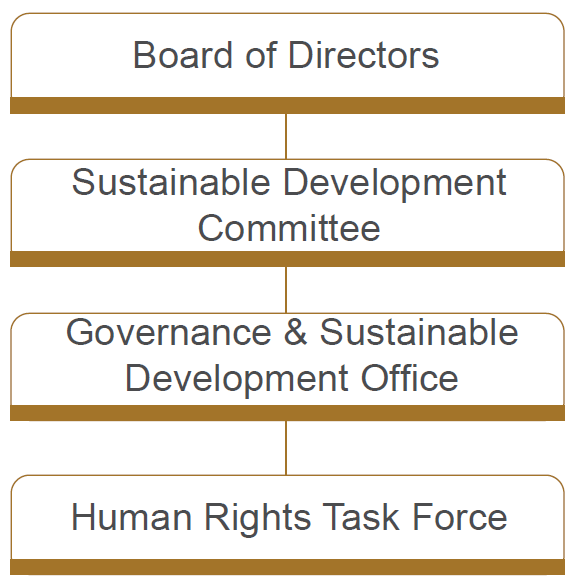
The Company has established a human rights governance structure with the Board of Directors as the highest-level authority, under the supervision of the Sustainable Development Committee. The Governance and Sustainable Development Office has established a cross-departmental human rights task force comprising various functional units, including operations, customer service, human resources, environmental, health and safety, information security, and materials and procurement. Through this structure, the Company systematically and effectively promotes human rights management initiatives. The Company reports on its human rights management initiatives and implementation results to the Board of Directors and the Sustainable Development Committee at least once a year.
Human Rights Due Diligence Process and Scope
The Company's due diligence approach is based on the European Union's Corporate Sustainability Due Diligence Directive and the OECD Due Diligence Guidance for Responsible Business Conduct. Based on these frameworks, the Company has established human rights due diligence procedures that identify and assess risks related to human rights issues, develop risk management and mitigation measures, implement improvements, and conduct follow-up monitoring to effectively reduce the impacts and adverse effects of human rights risks.
- Scope of due diligence: All employees of the Company and tier 1 suppliers.
- The human rights due diligence process includes: risk identification, establishment of communication channels, and regular monitoring and performance evaluation.
Human Rights Due Diligence and Status of Implementation
The scope of due diligence conducted cover key stakeholders, including employees and suppliers. For the aforementioned groups, the Company focuses on material human rights issues, including wages and working hours, health and safety, freedom of assembly and association, equal opportunity and nondiscrimination, and privacy protection.
Implementation of mitigation and remediation measures: To mitigate human rights risks and provide effective remediation mechanisms, the Company implemented the following measures in 2025:
- Establishment of diverse communication and grievance channels: Internally, the Company provides an employee grievance hotline and email address (hr@eyecenter.com.tw), regularly convenes quarterly labor-management meetings, and conducts interviews with new employees upon completion of their probationary periods as well as exit interviews with departing employees. Externally, the Company's official website has established a “Stakeholders” section, providing dedicated contact platforms for investors, customers, suppliers, and communities.
- Transparent and open feedback mechanisms: The Company's website features a “Stakeholders” section that provides communication and grievance channels for various stakeholder groups (https://www.uvb.com.tw/contact/contact_a04/). This mechanism ensures that diverse voices are given the appropriate attention and response.
Performance: Through the aforementioned investigation and monitoring mechanisms, the Company received no complaints related to human rights violations or suspected human rights abuses in 2025.
Human Rights Due Diligence and Management of Suppliers: The Company extends its commitment to protecting human rights throughout its value chain, and conducts human rights due diligence on suppliers. In addition to requiring suppliers to comply with the Company's human rights policies and applicable labor laws and regulations, the Company also incorporates suppliers’ working conditions, health and safety, and environmental protection into its assessment scope. Through the “Stakeholders” section on its official website, the Company provides dedicated communication and grievance channels for suppliers, ensuring that suppliers can promptly report potential human rights risks. Based on the content of grievances received, the Company will initiate investigations and, where necessary, provide guidance and implement corrective measures, working together with suppliers to build a sustainable supply chain that respects human rights.
In 2025, supplier surveys and grievance channels identified no incidents involving human rights abuses or suspected human rights violations by suppliers.